Crude Oil Differential
Where Can I Spread Bet on Differential Markets? |
You can currently spread bet on differential spread betting markets with:
What is a Differential Market? |
A differential market simply compares the difference between two financial markets.
Some of the more popular differential markets include:
As an example, if Brent Crude Oil is at $116.31 and US Crude Oil is at $105.30 then the difference between the two markets is $11.01. Therefore, a financial spread betting company like Capital Spreads may offer a spread for the Brent Crude Oil - US Crude Oil differential market of $10.98 - $11.04.
As a result, Capital Spreads’ clients could spread bet on the differential getting larger than $11.04 or getting smaller than $10.98.
In short, this differential market is a way of trading the relative performance of Brent Crude against US Crude.
If you feel that Brent Crude will outperform US Crude you could spread bet on the differential to rise. Conversely if you think US Crude Oil will perform best then you can spread bet on the differential to fall.
In fact, trading on a differential market is the same as trading on one of the markets to rise and the other market to fall, however with a differential trade:
- You only hold one position, rather than two, this makes it easier to manage your risk and any trading orders
- The combined spread of two distinct trades is larger than a differential. A differential trade offers spread bettors a way of getting a relatively tighter spread.
Note that differentials are quarterly or monthly futures markets and therefore they have a set expiry date. In the above example we considered a ‘May’ differential market so if your trade is still open then the market, and any remaining trades, will be settled on the relevant closing date in May. For more details, see the trading example below.
Where Can I find Charts for Differential Spread Betting Markets? |
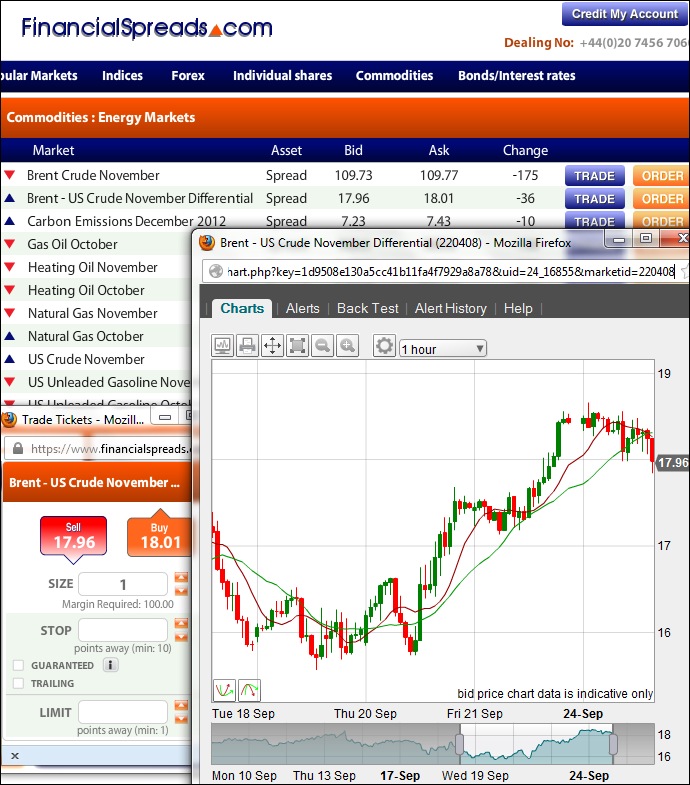
Investors can find candlestick charts with spread betting firms like Financial Spreads.
All Financial Spreads charts allow investors to alter the timeframe to view them by the minute, by the hour, by the day, by the week etc. There are also a wide range of other options and settings to help your technical analysis.

How to Spread Bet on the Brent Crude Oil - US Crude Oil Differential |
As with a wide range of commodities, investors can place a spread bet on differentials, such as the "Brent Crude Oil - US Crude Oil differential", to rise or fall.
At the time of writing Brent Crude Oil is priced at $115.77 whilst US Crude Oil is at $106.08.
Looking at Capital Spreads, they are currently giving the Brent Crude Oil - US Crude Oil (May) Differential market at $9.66 - $9.72. As a result, you could spread bet on the Brent Crude Oil - US Crude Oil differential:
- Closing higher than $9.72, i.e. Brent Crude Oil will perform more strongly, or
- Closing lower than $9.66, i.e. US Crude Oil will perform more strongly
On the expiry date for this 'May' market, 12-Apr-11.
When spread trading on the Brent Crude Oil - US Crude Oil differential you trade in £x per $0.01. As a result, if you decide to have a stake of £6 per $0.01 and the Brent Crude Oil - US Crude Oil market moves $0.05 then that would change your profits (or losses) by £30. £6 per $0.01 x $0.05 = £30.
Brent Crude Oil - US Crude Oil Differential Spread Betting Example
So, if you think about the spread of $9.66 - $9.72 and make the assumptions that:
- You have analysed the energies markets, and
- You think that Brent Crude will perform more strongly and so the Brent Crude Oil - US Crude Oil differential will settle higher than $9.72 by 12-Apr-11
Then you may buy a spread bet at $9.72 and invest, let’s say, £3 per $0.01.
So, you win £3 for every $0.01 that the Brent Crude Oil - US Crude Oil differential pushes above $9.72. Conversely, however, you will make a loss of £3 for every $0.01 that the Brent Crude Oil - US Crude Oil market falls below $9.72.
Looking at this from another angle, should you ‘Buy’ a spread bet then your profits (or losses) are found by taking the difference between the final price of the market and the price you bought the spread at. You then multiply that difference in price by the stake.
So if, on the expiry date, the Brent Crude Oil - US Crude Oil differential settled up at $10.11, then you would make a return of:
Profit / loss = (Settlement Level - Opening Level) x stake
Profit / loss = ($10.11 - $9.72) x £3 per $0.01 stake
Profit / loss = $0.39 x £3 per $0.01 stake
Profit / loss = £117 profit
Speculating on differentials, whether by spread trading or otherwise, is not always easy. With this example, you had bet that the market would go up. Nevertheless, the differential might decrease.
If US Crude Oil had performed better than Brent, with the Brent Crude Oil - US Crude Oil market decreasing and closing lower at $9.28, then this means you would end up making a loss and losing on this trade.
Profit / loss = (Settlement Level - Opening Level) x stake
Profit / loss = ($9.28 - $9.72) x £3 per $0.01 stake
Profit / loss = -$0.44 x £3 per $0.01 stake
Profit / loss = -£132 loss
Note: Brent Crude Oil - US Crude Oil May Differential spread betting market taken as of 24-Mar-11.
Financial Spreads » "With FinancialSpreads.com you get all the advantages of
Spread Betting as well as commission free CFD Trading on 2,500+ markets, 24 hour trading, professional level charts and..." read
Financial Spreads review.
|
'Crude Oil Differential' edited by Jenna Cutly, updated 22-Feb-17
For related articles also see:
Afternoon Trading Update, updated 22-Jun-15
The daily afternoon trading update on the main stock index, forex and commodities markets as the UK markets close. Insight comes from analysts at one of the leading companies in... » read analysis.
Morning Market Video, updated 18-Mar-15
The morning market video takes a quick look at what's happening in the stock markets today. It covers the big trading news, price updates and major market moving events as well as... » read analysis.
Morning Market Update, updated 19-Mar-15
With analysis straight from the trading floor, the daily morning market update has views and opinions on the popular forex, commodities and equities spread betting markets including... » read analysis.
Financial Market Review, updated 24-Jan-14
A daily market review of the key European and US markets as well as a quick look at the forex and commodities markets. In the last trading session we saw... » read analysis.
Commitments of Traders Guide, updated 20-May-18
A guide to the Commitments of Traders reports with weekly updates on the futures markets, understanding the signals, how to read the COT report and... » read guide.
Financial Market Afternoon Recap, updated 17-Mar-15
A recap of the main stock indices, FX and commodity markets as the London markets closed during the last trading session. We also have analysis and views on the latest... » read report.
Financial Market Morning Recap, updated 18-Mar-15
A recap of the major equity, FX and commodities markets as London was opening for the last trading day. We also have the latest market updates on... » read report.
Interesting Quotes and Videos, updated 13-Apr-17
Quote of the day plus the last 5 political, funny, topical and/or interesting quotes. We also have some classic political errors on video and... » read article.
About this page:
Crude Oil Differential
A comprehensive guide to crude oil differential spread betting including where to trade, what is the oil differential market, how to spread bet on Brent vs US crude, worked trading examples and... » read from top.
|

|
Q) Average Trading Results?
A) Get free trading tips, offers, price updates, important news and more!
|
|